

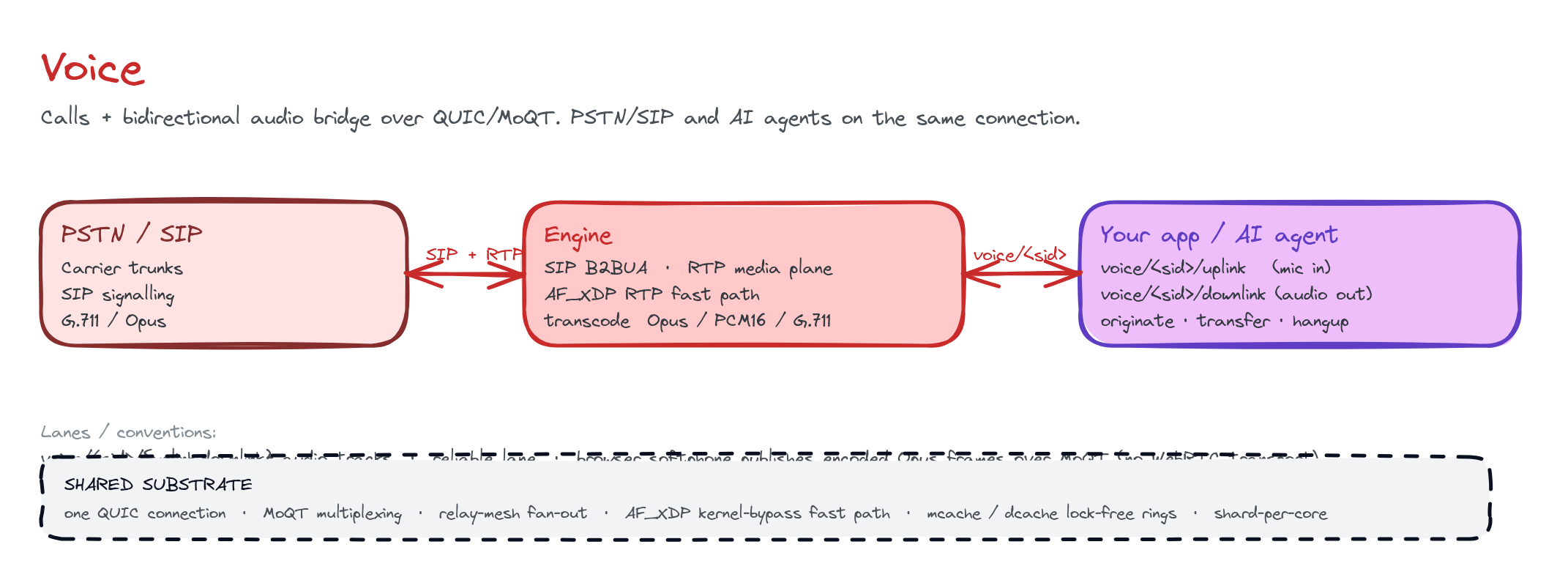
Voice: PSTN/SIP and browser clients bridge to an AI agent over QUIC/MoQT.
sid. The PSTN leg, the
SIP leg, the browser softphone leg, and the AI-agent leg all connect to it.
The two primitives (plus agents)
Calls — the control plane
Originate, fetch, transfer, and hang up calls. The API is HTTP-shaped and
idempotent. Every call returns a
Call handle keyed by a single sid. Use
this plane to manage a call.AudioBridge — the data plane
Bidirectional encoded audio over MoQT tracks at
voice/<sid>/{uplink,downlink}. The media flows on this plane. You can
subscribe to caller audio and publish audio back, frame by frame.sid. The
engine then connects the bridge end-to-end and drives the conversation for you.
You write the agent. You do not write the transport code.
The split is deliberate. The control plane is a request/response API that you
can call from any backend. The data plane is a low-latency media path. You use
the data plane only when you want the raw frames. For an AI voice agent, you
often use neither plane directly. You attach an agent, and the engine operates
both planes.
When to use it
Outbound + inbound calling
Originate calls to E.164 numbers over a SIP trunk. Accept inbound calls
that the SIP gateway terminates. One control surface serves both directions.
AI voice agents
Attach a speech-to-speech agent to a live call. The engine bridges audio
both ways and handles turn-taking and barge-in.
Programmable audio
Subscribe to caller audio (uplink) and feed it into your own ASR. Publish
synthesized audio (downlink) back. You have full codec control.
Browser softphone
Place and answer calls from the browser with encoded Opus over MoQT. The
media path has no SFU and no gateway round-trips.
The wire model
A call’s media is two MoQT audio tracks under a per-call namespace:voice/opus). The relay routes
on that capability. A recording sidecar, an ASR consumer, or an AI-agent attach
can subscribe to a call’s audio. The publisher does not know that these
subscribers exist. You route on intent, not on a hardcoded peer.
When you attach as the server, you subscribe to the uplink and publish the
downlink. When you attach as the browser caller, you do the opposite: you
publish the uplink (mic) and subscribe to the downlink (playback). Distinct
tracks for each direction prevent self-subscribe feedback.
Call lifecycle
The control plane reports a status. The status moves monotonically toward a terminal state:originate() returns as soon as the call is dialing. Fetch the call again to
read the latest status. transfer() points the live audio at a new number (a
SIP REFER on the wire) or attaches a different agent. The sid stays the
same. hangup() ends the call and drops both tracks.
A SIP gateway terminates inbound PSTN calls. The gateway acts as a
back-to-back user agent (B2BUA). It negotiates signalling with the carrier. It
answers the call. It publishes the audio onto the same
voice/<sid>/{uplink,downlink} tracks. At the SDK surface, an inbound call
looks the same as an outbound one.
Codecs
The bridge transcodes between the codec that the call leg negotiated and the codec that your code requests. For example: PSTN µ-law comes in, your code receives Opus, your code sends Opus, and µ-law goes back out. Your process needs no media tooling.
Inside the runtime, audio is single-channel PCM16 at 8 kHz end-to-end. The
browser path negotiates Opus. The carrier leg negotiates G.711.
The browser softphone path
The browser places audio on the same MoQT tracks as every other client. There is no SFU on this path:1
Capture + encode
The SDK’s capture helper runs the browser’s own capture graph (echo
cancellation, gain control, noise suppression). It then diverts the
encoded Opus frames onto the uplink track through encoded / insertable
streams. Raw PCM never crosses the wire. The SDK uses only the browser’s
Opus encoder. It never uses the browser’s WebRTC transport.
2
Publish over QUIC/MoQT
The SDK writes each encoded frame to
voice/<sid>/uplink as a MoQT object
over WebTransport. The relay fans the frame out to each endpoint that the
engine bridged the call to: the SIP leg, an agent, or a recorder.3
Subscribe + play back
Downlink Opus arrives on
voice/<sid>/downlink. The SDK player decodes it
with WebCodecs. The player renders the audio through an audio worklet ring
buffer and pads silence on underrun.QUIC/MoQT over WebTransport is first-class and is the default browser path
(Chrome-family). On Safari, on UDP-blocked corporate networks, or on TCP-only
proxies, the client falls back to a WebSocket (control/data) or WebRTC (media)
leg. See
Browser compatibility.
How it works
You get telephony-grade latency at fleet scale. You do not run any media infrastructure. These mechanisms make that possible:- One connection carries everything. Your audio multiplexes over the same MoQT substrate as every other modality. All traffic uses a single QUIC/HTTP-3 connection on port 443. One auth token authorizes the whole connection. There is no per-track setup.
- The media path skips the kernel. The SIP/RTP leg uses a kernel-bypass zero-copy fast path. For steady-state media, packets move between the NIC and userspace and do not pass through the kernel networking stack.
- No lock contention on the hot path. A shard-per-core reactor pins each call to the core that owns it. A flow classifier steers packets to that shard. Cross-shard hand-off uses lock-free rings. A call never takes a lock while media flows.
- io_uring drives async I/O so the media shards stay off the scheduler’s critical path.
- Secure by default. Every QUIC connection uses TLS 1.3. Call handshakes use ECDSA for low per-core signing cost.
Next steps
Quickstart
Ship a voice agent in minutes on the managed cloud. You run no
infrastructure.
Core concepts
The end-to-end architecture: signalling, media, transport, and the agent
runtime.
Sessions, calls, tracks & streams
The object model behind the
sid. It shows how legs, tracks, and
namespaces fit together.Agent runtime
Bring your own ASR/LLM/TTS or a speech-to-speech provider. This page also
covers tools and the session lifecycle.